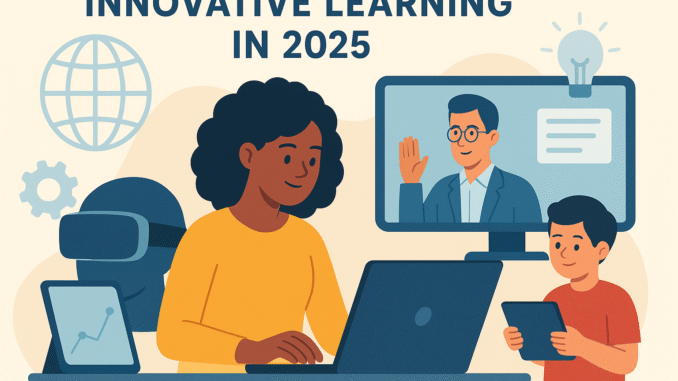
Innovative Learning in 2025: How Technology Is Transforming Education for All
Introduction: A New Era of Learning
Education in 2025 looks vastly different from what we knew just a decade ago. Classrooms are no longer confined by four walls, textbooks are no longer the sole source of knowledge, and students are no longer passive recipients of information. Instead, learning is interactive, personalized, and accessible to anyone with an internet connection.
This transformation is driven by rapid advances in technology, shaping not only how we teach but also how students engage with knowledge. From artificial intelligence (AI) to virtual reality (VR) and adaptive learning platforms, innovative tools are bridging gaps, breaking barriers, and opening doors for learners of all backgrounds.
In this article, we explore how technology is revolutionizing education in 2025, its benefits, challenges, and what the future might hold.
1. Personalized Learning Through Artificial Intelligence
One of the most significant breakthroughs in modern education is the use of AI-powered learning systems. These platforms analyze a student’s strengths, weaknesses, and learning pace to create tailored lesson plans.
For example:
- Adaptive quizzes adjust difficulty based on performance.
- Recommendation engines suggest extra practice in weaker areas.
- AI tutors provide instant feedback and explanations.
This approach ensures that no two students have the exact same learning experience. A fast learner can move ahead without being held back, while someone struggling with a topic can get extra time and resources.
Impact in 2025:
AI has made it possible to reach students who might otherwise fall behind, reducing dropout rates and boosting academic performance.
2. Virtual and Augmented Reality: Learning Beyond the Classroom
Virtual Reality (VR) and Augmented Reality (AR) have transformed lessons into immersive experiences. Students can now:
- Walk through ancient Rome in history class.
- Explore the human body in 3D for biology.
- Conduct science experiments in a risk-free virtual lab.
By making learning more interactive and visual, VR and AR help students retain information better.
Real-world example: In 2025, many universities and schools are offering “virtual field trips,” allowing students to visit museums, landmarks, and even outer space—all from their classrooms or homes.
3. The Rise of EdTech Platforms
Online learning platforms have been around for years, but in 2025, they’ve become smarter and more inclusive. From global MOOCs (Massive Open Online Courses) to localized mobile learning apps, education is now available anytime, anywhere.
Key developments:
- Language translation tools allow students to take courses in their preferred language instantly.
- Gamified learning uses rewards and challenges to keep students motivated.
- Peer-to-peer learning communities connect students worldwide for collaborative projects.
These platforms break down geographical and economic barriers, enabling learners from rural areas or developing countries to access the same quality content as those in major cities.
4. Remote and Hybrid Learning: The New Normal
While remote learning gained momentum during the pandemic years, by 2025 it has matured into a hybrid model that combines the best of in-person and online education.
Advantages of hybrid learning:
- Flexibility – Students can choose how and when they learn.
- Accessibility – Working students or parents can pursue education without disrupting their schedules.
- Inclusivity – Students with disabilities benefit from customizable learning environments.
Many institutions now use blended classrooms, where part of the lesson happens in-person, and part is conducted online using interactive tools.
5. Data-Driven Teaching
Technology in 2025 allows teachers to make data-informed decisions about their students’ progress.
- Learning analytics dashboards show real-time performance trends.
- Early-warning systems alert educators when a student might be at risk.
- Teachers can adjust their methods instantly to improve outcomes.
This approach shifts teaching from a one-size-fits-all model to a dynamic, results-driven process.
6. Lifelong Learning and Micro-Credentials
In the fast-changing job market of 2025, education doesn’t stop at graduation. Technology has made lifelong learning not only possible but essential.
- Micro-credentials: Short, skill-specific certifications that employers recognize.
- Online workshops and nanodegrees for quick upskilling.
- AI-powered career planning tools that recommend new learning paths based on job trends.
This shift helps workers stay competitive and adapt to emerging industries without returning to school full-time.
7. Accessibility and Inclusivity: Education for All
Perhaps the most inspiring impact of technology is its role in making education more inclusive.
- Screen readers and speech-to-text tools support visually and hearing-impaired learners.
- Customizable learning interfaces allow neurodiverse students to adjust colors, fonts, and layouts.
- Affordable mobile devices bring education to remote villages.
By breaking down barriers for marginalized groups, technology is helping create a more equitable global education system.
8. Challenges in Tech-Driven Education
Despite its benefits, tech-based education in 2025 faces challenges:
- Digital divide – Not all students have equal access to devices or reliable internet.
- Over-reliance on technology – Critical thinking and interpersonal skills can suffer without balance.
- Privacy concerns – Storing student data raises security and ethical issues.
- Teacher training – Educators need ongoing training to effectively use new tools.
Addressing these challenges is key to ensuring technology remains a tool for empowerment rather than exclusion.
9. The Future of Learning: What’s Next?
Looking ahead, several innovations are on the horizon:
- AI-powered mentors that guide students through entire academic journeys.
- Brain-computer interfaces for faster, more intuitive learning.
- Global classroom networks connecting learners in real time across continents.
As technology continues to evolve, the focus will remain on human-centered learning—using innovation to enhance creativity, empathy, and critical thinking.
Conclusion: A World of Possibilities
In 2025, technology is not replacing teachers—it’s empowering them. It’s not eliminating traditional learning—it’s enhancing it. By making education more personalized, accessible, and engaging, innovative tools are creating opportunities for everyone, everywhere.
The transformation we see today is just the beginning. With the right balance of technology, human interaction, and ethical considerations, the future of education promises a world where learning truly has no limits.